

Hair transplant recovery is a slow, staged process, and almost every patient has a moment of doubt along the way. The grafts look promising in week one, then many of them shed, and for a few months it can seem as if nothing has happened.
This guide walks through hair transplant recovery month by month, from the first night to the final result at about a year. It explains what is normal at each stage, how to care for the recipient and donor areas, and which signs mean you should call your clinic.
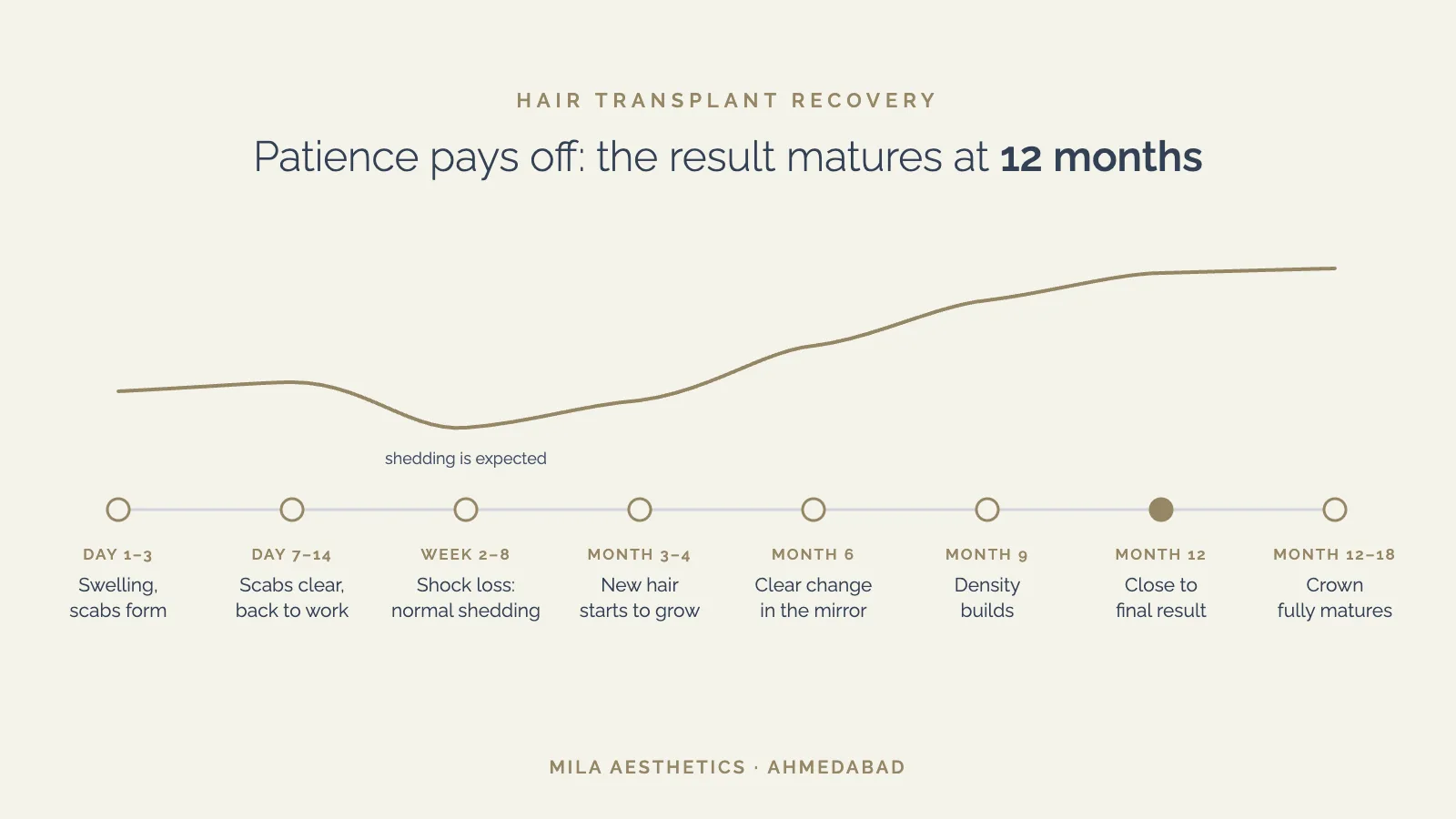
Most people return to desk work within 3–7 days, and scabs usually clear by day 10–14. Transplanted hairs commonly shed between weeks 2 and 8; this is normal. New growth starts around month 3–4, density builds through months 6–9, and the result is close to final at about 12 months, or up to 18 months for the crown.
Hair transplant recovery timeline at a glance
Every patient heals at their own pace, but the stages of hair transplant recovery follow a familiar pattern. The timeline below shows the typical milestones.
| Stage | What usually happens |
|---|---|
| Days 1–3 | Mild swelling, tenderness and small scabs form around each graft |
| Days 4–7 | Swelling settles; gentle washing begins as advised; most people return to desk work |
| Days 7–14 | Scabs loosen and fall away; redness fades gradually |
| Weeks 2–8 | Shock loss: many transplanted hairs shed while the roots stay in place |
| Months 3–4 | New hairs begin to grow, usually fine and thin at first |
| Months 5–8 | Growth becomes more visible; hairs thicken and darken |
| Months 9–12 | Density and texture continue to improve; the result is close to final |
| Months 12–18 | Final maturing, especially at the crown |
Hair transplant recovery in the first two weeks
The first fortnight sets up the whole result. The grafts are anchoring into the scalp, so the main job is to protect them while the skin heals.
Days 1–3: rest and protect
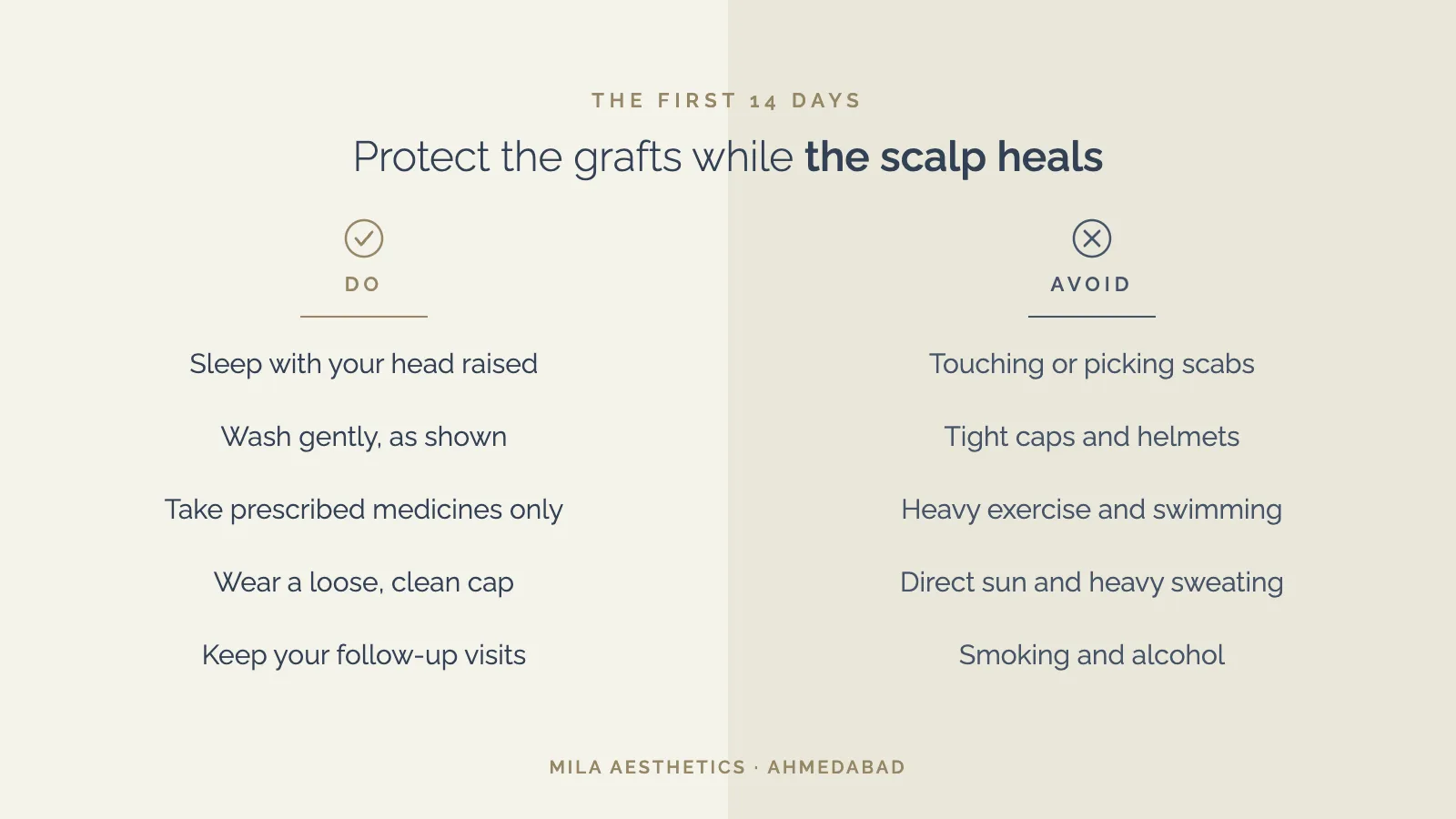
- Sleep with your head raised on two pillows to limit swelling.
- Some swelling across the forehead around days 2–4 is common and settles on its own.
- Do not touch, scratch or rub the grafts, and avoid tight caps or helmets.
- Take only the medicines your surgeon has prescribed.
Days 4–7: gentle washing begins
Your clinic will show you how and when to wash. Washing is usually done by gently pouring water and patting on a mild shampoo, never by rubbing. Most people with office jobs return to work in this window, often wearing a loose cap if they prefer.
Days 7–14: scabs clear
Small crusts loosen with careful washing and usually fall away by the end of the second week. Let them come off naturally. Pinkness in the recipient area can last a few weeks, a little longer on fair skin.
Weeks 2–8: shock loss is part of hair transplant recovery
Between roughly weeks 2 and 8, many of the transplanted hairs fall out. This is called shock loss, and it is the stage that worries patients most.
The important point is that the hair shaft sheds, but the follicle stays safely in the scalp. Each follicle rests for a while, then starts a new growth cycle. Some nearby native hairs may also shed temporarily for the same reason.
During this phase your scalp may look much like it did before surgery. That is expected and is not a sign that the procedure has failed.
Hair transplant recovery month by month
Month 1
Scabs have gone and redness is fading. Shedding is under way, so the transplanted area often looks thin. Most people are back to normal routines, with exercise reintroduced gradually as your surgeon advises.
Months 2–3
This is often called the “ugly duckling” phase. Shedding is complete and new growth has not yet surfaced. Small pimple-like bumps can appear as new hairs push through the skin; tell your clinic if they are painful or many.
Months 3–4
New hairs begin to appear. They are usually fine, soft and sometimes lighter in colour. Growth is uneven at first, with some areas filling in before others.
Months 5–6
This is when many patients first notice a clear change in the mirror. Hairs are longer and starting to thicken, and the hairline becomes easier to see.
Months 7–9
Density builds steadily. Hairs continue to thicken and darken, and the transplanted area begins to blend with the surrounding hair, which makes styling easier.
Months 10–12
For the hairline and front of the scalp, the result is close to final. Texture keeps maturing, and any temporary waviness or coarseness usually settles.
Months 12–18
The crown often takes longer to finish, so allow up to 18 months before judging it. This is also the right time to review the result with your surgeon and discuss whether anything further is needed.
Donor area recovery
The donor area at the back of the head usually heals faster than the recipient area. After FUE, it carries tiny dot-like wounds that crust over and heal within about one to two weeks.
- Redness and scabs usually settle within 7–10 days.
- Numbness or tingling can last a few weeks, occasionally a few months, and normally fades.
- Hair grows back over the area within a few weeks, hiding the small marks.
- Tightness or mild discomfort eases as the skin heals.
Good planning of the donor area matters for the long term. Our guide to hair transplant cost in Ahmedabad explains why over-harvesting the donor area is a common problem with very cheap procedures.
Daily life during hair transplant recovery
Sleeping
For the first week, sleep on your back with your head raised, and avoid pressing the grafts against the pillow. A travel pillow helps keep your head still. After about a week to ten days, most people return to their usual position.
Work and social plans
Desk work is usually possible within 3–7 days. If you would rather nobody notices, allow 10–14 days, when scabs have cleared and redness has faded. Jobs that involve heavy lifting, heat or dust usually need a little longer off.
Hats, helmets and haircuts
A loose, clean cap is usually fine after the first few days; tight caps and helmets are avoided until your surgeon says the grafts are secure. Ask before your first haircut: a scissor trim of the surrounding hair is often fine after a few weeks, while clippers directly on the grafts are usually left for longer.
Travel and weather
Short trips are usually possible after the first few days. In Ahmedabad’s heat, avoid long periods in direct sun and heavy sweating in the early weeks, and keep the scalp clean as your clinic advises.
What can slow hair transplant recovery down
- Smoking: reduces blood flow to the scalp; stop well before and after surgery, as advised.
- Touching or picking scabs: can dislodge grafts in the first 10 days.
- Heavy exercise too early: raises blood pressure and sweating; return gradually as your surgeon advises.
- Sun exposure: protect the scalp with a loose hat in the early weeks, and use sunscreen once your clinic allows it.
- Swimming: pools and the sea are usually avoided for the first few weeks.
- Ongoing hair loss: native hair can keep thinning, so many patients use supportive treatment such as PRP, GFC or mesotherapy alongside surgery.
When to call your clinic during recovery
Most of hair transplant recovery is uneventful, but contact your clinic promptly if you notice:
- Redness that is spreading rather than fading
- Pus, a bad smell or increasing pain after the first few days
- Fever or feeling generally unwell
- Bleeding that does not stop with gentle pressure
- Many painful bumps in the recipient area
The International Society of Hair Restoration Surgery also publishes patient information on hair loss and surgery.
Hair transplant recovery at MILA Aesthetics
At MILA Aesthetics in Bodakdev, Ahmedabad, every hair transplant comes with written aftercare instructions and follow-up visits through the growth phase, so you know what is normal at each stage. If this is your first procedure, read our guide for first-time patients, and if thinning is mainly at the back of your head, see crown thinning causes and treatment.
Frequently asked questions
How long is hair transplant recovery?
The visible healing takes about 10–14 days, and most people return to desk work within 3–7 days. Full results take about 12 months, or up to 18 months at the crown.
Is it normal for transplanted hair to fall out after a month?
Yes. Shock loss between weeks 2 and 8 is a normal part of hair transplant recovery. The hair shaft sheds, but the follicle stays in place and starts a new growth cycle.
When will I see results after a hair transplant?
New growth usually appears around months 3–4. Many people notice a clear change by month 6, and the result is close to final at about 12 months.
When can I wash my hair after a hair transplant?
Your clinic will advise you, but gentle washing usually starts within the first few days, using a pouring and patting technique rather than rubbing.
How long does the donor area take to heal?
After FUE, the donor area usually heals within one to two weeks. Mild numbness can last a few weeks and normally fades, and hair grows back over the area.
When can I exercise after a hair transplant?
Light walking is usually fine within days. Heavy exercise, swimming and contact sports are generally avoided for a few weeks; follow your surgeon’s advice.
Final thoughts
Hair transplant recovery asks for patience more than anything else. Expect healing in two weeks, shedding in the first two months, new growth from month three or four, and a mature result at around a year. Knowing what is normal at each stage makes the wait much easier.
Plan your hair transplant with confidence
Visit MILA Aesthetics, Sylph 203, Sindhu Bhavan Marg, Bodakdev, Ahmedabad.
WhatsApp us Call 83474 47477