

You look in the mirror and notice something you weren’t expecting: your front hairline still looks pretty much the same, but there are signs of crown thinning: the hair at the top and back of your head seems sparser.
It’s a common pattern, and it can be confusing.
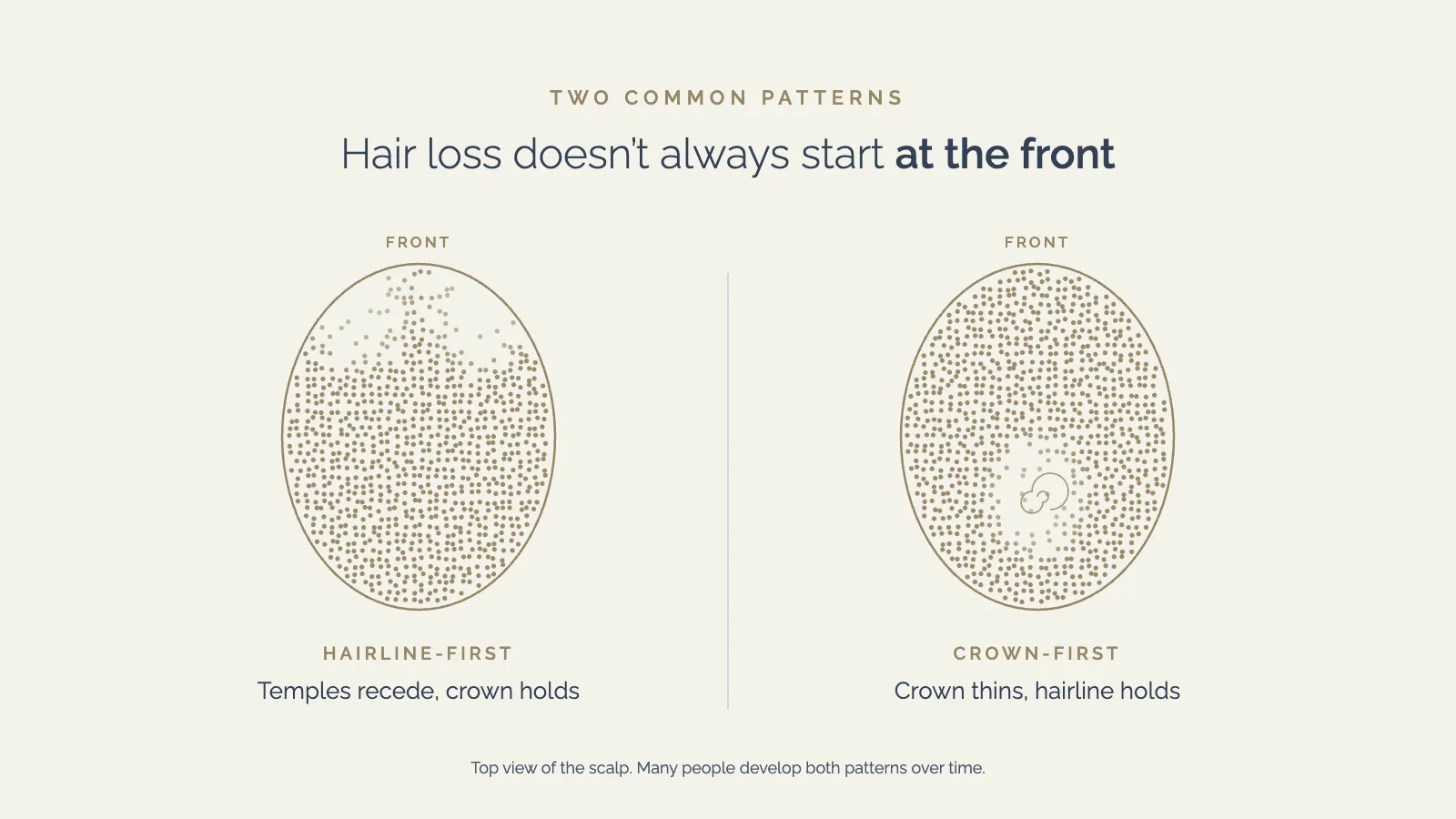
Most people associate hair loss with a receding hairline or widening forehead. But hair thinning doesn’t always follow that route. For some people, the crown is where reduced density becomes noticeable first.
The crown, also called the vertex, is the area toward the back and top of the scalp. Because of the way hair grows and the direction in which it lies, early thinning in this area can sometimes go unnoticed until it becomes more obvious under bright lighting, in photographs, or when the hair is wet.
So, why is your crown thinning while your front hairline remains intact?
There are several possible explanations. Pattern hair loss is one of the most common, but it’s not the only possibility.
Understanding the cause is important because different types of hair loss can require very different approaches.
What Does Crown Thinning Look Like?
Crown thinning doesn’t always mean you’ll suddenly see a bald spot.
In the early stages, you may notice:
- More scalp showing through the hair
- A wider-looking natural hair whorl
- Reduced density around the crown
- Finer hairs compared with surrounding areas
- Hair that looks flatter than it used to
- More scalp visibility under overhead lighting
- Increased visibility when your hair is wet
- A circular or diffuse area of reduced density
Sometimes the change is subtle enough that someone else notices it before you do.
Taking photos of your crown periodically under similar lighting can help you determine whether the density is actually changing over time.
Why Does Crown Thinning Start Before the Hairline Recedes?
The short answer is hair follicles don’t all behave the same way.
Different follicles have different genetic characteristics and different sensitivities to hormonal influences.
In androgenetic alopecia, also known as pattern hair loss, susceptible follicles gradually become smaller. This process is called miniaturization.
Hair that once grew thick and strongly may gradually become:
- Thinner
- Shorter
- Less pigmented
- Less noticeable
Over time, the overall density can decrease.
The crown can be particularly susceptible to this process in some people, while the frontal hairline remains relatively preserved.
That’s why you can have noticeable crown thinning without a dramatic receding hairline.
8 Common Causes of Crown Thinning
Pattern hair loss is the most common reason, but it is not the only one. These are the causes a specialist will usually consider.
1. Androgenetic Alopecia
One of the most common explanations for crown thinning is androgenetic alopecia.
It’s often called male pattern hair loss in men and female pattern hair loss in women, although the patterns aren’t identical.
Genetics play a major role. The American Academy of Dermatology describes hereditary hair loss as the most common type of hair loss in both men and women.
The hormone dihydrotestosterone (DHT) is involved in the process in genetically susceptible follicles. However, it’s more accurate to think of pattern hair loss as a complex interaction between genetics, hormones, age, and follicle sensitivity rather than simply saying “DHT causes baldness.”
In some individuals, crown follicles are more sensitive to these influences than the follicles around the frontal hairline.
This can lead to a familiar pattern:
Crown thinning → increasing scalp visibility → expanding area of reduced density
while the front hairline remains relatively stable.
2. Your Hair Loss Pattern May Simply Be Different
Not everyone follows the same hair-loss pattern.
Some people experience:
- Receding temples first
- Crown thinning first
- Diffuse thinning across the scalp
- A combination of frontal and crown thinning
- More noticeable thinning across the central part
Genetics largely influence where and how rapidly follicles become susceptible.
So, an intact hairline doesn’t necessarily mean you aren’t experiencing pattern hair loss. If your temples are the area changing instead, read why your hairline may be receding.
3. Age Can Play a Role
Hair characteristics naturally change as we get older.
Hair growth cycles can change, and individual strands may become finer.
At the same time, conditions that contribute to hair loss may become more apparent with age.
This doesn’t mean that crown thinning is simply “normal ageing” and should automatically be ignored.
If you’ve noticed a meaningful change in density, it’s worth identifying why it’s happening.
4. Stress-Related Hair Shedding
Stress can trigger a type of excessive shedding called telogen effluvium.
Unlike typical pattern hair loss, telogen effluvium often causes more diffuse shedding across the scalp.
You may notice:
- More hair on your pillow
- Increased shedding while showering
- Hair coming out when brushing
- Overall reduced density
The trigger can sometimes occur weeks or months before the shedding becomes obvious. We explain this further in can stress cause acne and hair loss?
Potential triggers include:
- Significant emotional stress
- Major illness
- Surgery
- Rapid weight loss
- Severe dietary restriction
- High fever
- Certain medications
- Major hormonal changes
Because telogen effluvium is usually diffuse, it doesn’t necessarily target only the crown. However, reduced density can make an existing crown-thinning pattern more noticeable.
5. Nutritional Deficiencies
Hair growth depends on adequate nutrition.
Deficiencies involving nutrients such as iron or other essential nutrients can contribute to hair shedding in some people.
However, taking supplements without knowing whether you’re deficient isn’t always helpful.
In fact, excessive intake of certain supplements can itself cause problems.
If nutritional deficiency is suspected, a healthcare professional may recommend an appropriate medical history, examination, and laboratory testing.
6. Scalp Conditions
Certain scalp conditions can contribute to hair shedding or make the scalp look thinner.
Examples include:
- Seborrheic dermatitis
- Psoriasis
- Fungal infections
- Inflammatory scalp disorders
Symptoms such as itching, redness, scaling, pain, or significant flaking shouldn’t simply be dismissed as ordinary hair loss.
A scalp examination can help distinguish between pattern hair loss and other conditions.
7. Hairstyles and Mechanical Stress
Repeated tension can contribute to hair loss.
Tight hairstyles such as:
- Very tight ponytails
- Tight braids
- Extensions
- Certain hair systems
can place ongoing stress on follicles.
This is known as traction alopecia.
It’s usually more noticeable around areas exposed to repeated tension, but the exact distribution depends on the hairstyle and habits.
8. Hair Breakage Isn’t Always Hair Loss
Here’s another easy one to overlook.
Sometimes the issue isn’t that the follicles are producing fewer hairs—it’s that the hair shafts are breaking.
Heat styling, chemical treatments, aggressive brushing, bleaching, and other forms of damage can make hair appear less dense.
Look closely at the strands.
If you’re seeing lots of short, broken hairs rather than shedding from the root, hair-shaft damage may be contributing to the appearance.
How Can You Tell If Your Crown Is Actually Thinning?
The crown is tricky to assess because everyone has a natural hair whorl.
Lighting can also dramatically change how much scalp is visible.
For a more meaningful comparison, take photographs:
- Under similar lighting
- From the same distance
- With similar hair length
- From the same angle
- At regular intervals
Avoid comparing a brightly lit photograph from today with an old photo taken in dim lighting.
If the visible area around the crown is gradually expanding, or the hair appears progressively finer, that may indicate genuine density loss.
What Does Miniaturization Mean?
Miniaturization is an important concept when discussing pattern hair loss.
A healthy terminal hair can gradually become thinner and shorter when a follicle is affected by pattern hair loss.
Instead of producing a thick strand, the follicle may produce a finer strand.
Over time, the difference can become obvious.
This is one reason early assessment can be useful.
A dermatologist or hair specialist may use magnification or dermoscopy to examine the scalp and compare the thickness and appearance of individual hairs.
How Is Crown Hair Loss Diagnosed?
A proper diagnosis starts with your history.
A doctor may ask:
- When did you first notice the thinning?
- Is it getting worse?
- Does hair loss run in your family?
- Are you experiencing increased shedding?
- Have you recently been ill?
- Have you lost weight?
- What medications do you take?
- How do you care for your hair?
- Do you have scalp itching or scaling?
- Have you experienced hormonal or health changes?
A scalp examination can then provide additional information.
In selected cases, blood tests or other investigations may be recommended to look for underlying contributors. The AAD hair loss resource center gives a useful overview of the different types of hair loss doctors look for.
Can Crown Thinning Be Treated?
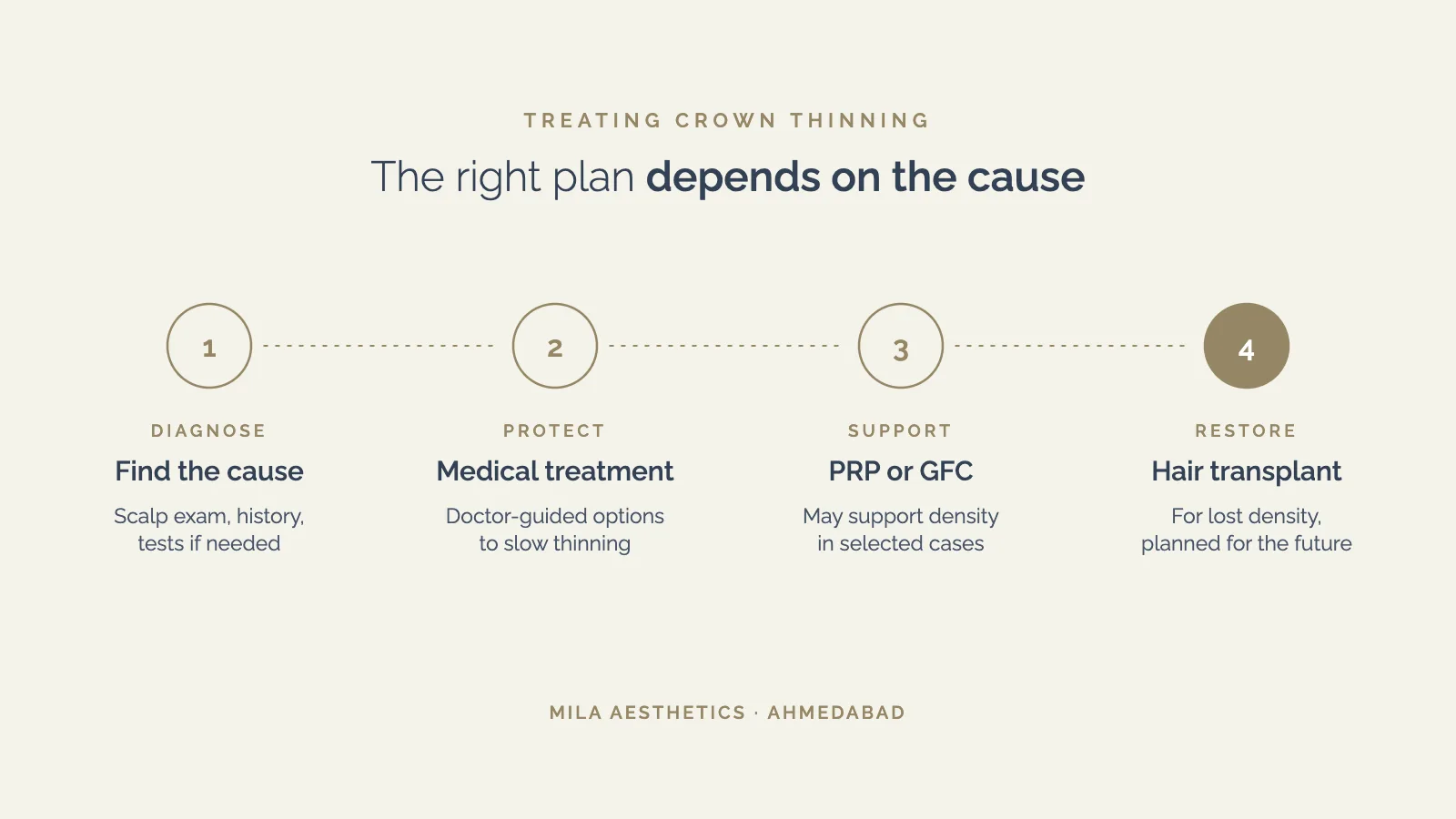
The answer depends on the cause.
If the issue is androgenetic alopecia, several evidence-based approaches may be discussed with a qualified healthcare professional.
Treatment goals may include:
- Slowing further hair loss
- Preserving existing follicles
- Improving hair density
- Supporting regrowth where follicles remain viable
The earlier the cause is identified, the more options may be available.
However, no treatment can guarantee complete restoration of hair that has been permanently lost.
Medical Treatments for Crown Thinning
Depending on the individual’s sex, age, medical history, and diagnosis, a doctor may discuss medications such as minoxidil.
Minoxidil
Minoxidil is an established treatment used for certain forms of pattern hair loss.
It may help reduce hair loss and support regrowth in some people.
It generally requires consistent use, and results can take time.
Stopping treatment may cause the benefits to diminish.
Other Prescription Options
For some patients, doctors may consider prescription medications that affect androgen pathways.
These aren’t appropriate for everyone.
For example, certain medications have important safety considerations for women who are pregnant or may become pregnant.
This is why prescription hair-loss treatments should be discussed with a qualified clinician rather than started based on internet recommendations.
What About PRP or GFC Hair Treatments?
Regenerative or growth-factor-based treatments such as platelet-rich plasma (PRP), GFC and mesotherapy are also offered for crown thinning and other hair thinning.
Research into these approaches continues, and outcomes can vary. Our guide to GFC hair treatment results explains what to expect.
They may be considered as part of a broader treatment plan for selected patients, but they’re not a guaranteed cure for pattern hair loss.
If you’re considering an injectable hair treatment, ask what evidence supports the specific procedure, how many sessions are recommended, what improvement is realistic, and how outcomes will be assessed.
Can a Hair Transplant Fix Crown Thinning?
A hair transplant can sometimes be used to restore density in the crown and treat advanced crown thinning.
During transplantation, follicles from a suitable donor area are moved into areas affected by hair loss.
However, the crown requires careful planning.
Why?
Because the crown has a natural spiral growth pattern. Creating an aesthetically appropriate direction and density requires thoughtful placement.
A surgeon also needs to consider your future hair loss.
If the front hairline is currently intact but the crown is thinning, the surgeon should assess the overall pattern rather than focusing only on the visible bald or thinning area.
Your donor supply is limited.
Using too many grafts for the crown without considering future progression may not be a good long-term strategy. Techniques also differ; see DHI vs FUE hair transplant for how they compare.
Is Hair Transplant the First Treatment You Should Try?
Not necessarily.
If the follicles are still miniaturized rather than permanently lost, medical treatment may be considered first or alongside other approaches.
A transplant can add density where follicles are no longer producing adequate hair, but it doesn’t necessarily prevent future native-hair loss.
That’s why diagnosis and long-term planning matter. Our comparison of PRP vs hair transplant can help you understand when each makes sense.
Can Crown Hair Grow Back Naturally?
It depends on what’s causing the thinning.
Temporary shedding caused by an identifiable trigger may improve as the underlying issue resolves.
For pattern hair loss, spontaneous complete regrowth is less likely once significant follicle miniaturization or permanent loss has occurred.
This is one reason not to wait indefinitely while hoping the problem will disappear.
Does Cutting Your Hair Make the Crown Thicker?
No.
Cutting hair doesn’t increase the number of follicles or change the thickness of hair growing from the scalp.
Shorter hair can sometimes make the hair look fuller because the strands appear more uniform, but it doesn’t treat the underlying cause of hair loss.
Can Diet Stop Crown Hair Loss?
A balanced diet supports normal hair growth, but diet alone generally can’t reverse genetically driven pattern hair loss.
If you have a genuine nutritional deficiency, correcting it may be important.
The key is identifying whether a deficiency actually exists rather than taking multiple supplements blindly.
A healthy diet should include adequate:
- Protein
- Iron
- Zinc
- Vitamins
- Essential nutrients
Your healthcare professional can advise whether testing is appropriate.
When Should You See a Specialist About Crown Thinning?
Don’t wait until the crown becomes visibly bald.
Consider seeking professional evaluation if you notice:
- Gradually increasing crown visibility
- Finer hair around the crown
- Persistent shedding
- A widening area around the hair whorl
- Sudden or patchy hair loss
- Scalp redness or scaling
- Itching or pain
- Hair loss accompanied by other health symptoms
- A strong family history of pattern hair loss
Early assessment doesn’t necessarily mean you’ll need an aggressive treatment.
It simply gives you a better understanding of what’s happening.
Crown Thinning Treatment in Ahmedabad
If you’re searching for crown hair loss treatment in Ahmedabad, start by finding out what is actually causing your thinning.
A reputable clinic should evaluate your scalp and hair pattern rather than automatically recommending a particular procedure.
Depending on the diagnosis, treatment discussions may include:
- Medical hair-loss management
- Minoxidil or other appropriate medications
- PRP or other injectable approaches
- GFC-based treatments where clinically appropriate
- Scalp and nutritional management
- Hair transplantation for selected cases
- Combination treatment
The right plan should be personalized.
There isn’t one treatment that works equally well for every cause of crown thinning. At MILA Aesthetics in Bodakdev, Ahmedabad, every hair restoration plan starts with a scalp assessment, and our hair transplant assessment is available at no cost.
How Can You Protect Your Existing Hair?
While you can’t change your genetics, several habits can support overall hair and scalp health.
Avoid Excessive Traction
Try not to repeatedly wear hairstyles that pull tightly on the scalp.
Be Gentle With Wet Hair
Wet hair can be more vulnerable to mechanical damage. Avoid aggressive brushing or pulling.
Limit Excessive Heat
Frequent high-heat styling can contribute to hair-shaft damage and breakage.
Treat Scalp Problems
Persistent itching, scaling, redness, or inflammation should be evaluated rather than ignored.
Avoid Random Supplements
More isn’t always better. Take supplements when medically appropriate and avoid excessive doses.
Track Changes
Photographs can help you and your clinician understand whether the condition is stable or progressing.
Frequently Asked Questions
Why is my crown thinning but my hairline isn’t receding?
Pattern hair loss doesn’t affect every follicle equally. Some people are genetically more susceptible to thinning around the crown while their frontal hairline remains relatively preserved.
Is crown thinning always male pattern baldness?
No. Androgenetic alopecia is common, but stress-related shedding, nutritional deficiencies, scalp conditions, medications, and other causes can contribute to thinning.
Can crown thinning be reversed?
It depends on the cause and how advanced the hair loss is. Some temporary causes can improve, while pattern hair loss may be managed but not completely reversed.
Does an intact hairline mean I’m not going bald?
No. Hair loss can begin or progress primarily at the crown while the frontal hairline remains intact.
Can stress cause crown thinning?
Stress can trigger telogen effluvium, which usually causes diffuse shedding. It can also make existing pattern hair loss more noticeable.
Is crown hair loss hereditary?
It can be. Genetics play a major role in androgenetic alopecia, although family history isn’t the only factor.
Can a hair transplant restore a thinning crown?
A transplant may restore density in selected patients. Suitability depends on the cause of hair loss, donor supply, degree of thinning, and expected future progression.
Should I wait until my crown becomes bald before seeking treatment?
No. If thinning is progressive, early evaluation may provide more opportunities to preserve existing hair.
The Takeaway
An intact front hairline doesn’t mean your hair is necessarily safe from thinning.
The crown can be affected independently because hair follicles have different levels of genetic and hormonal sensitivity. For many people, androgenetic alopecia is the main explanation, but temporary shedding, nutritional issues, scalp conditions, medications, and hair damage can also contribute.
The important thing is to avoid guessing.
If you’ve noticed that your crown is becoming more visible, take consistent photographs, pay attention to changes in shedding and hair thickness, and consider getting a professional scalp assessment.
For people looking for crown hair loss treatment in Ahmedabad, the best starting point is a proper diagnosis. Once the cause is understood, treatment can be tailored around preserving existing hair, improving density where possible, and planning for the long term.
Your hairline may still look exactly the same, but that doesn’t mean crown thinning should be ignored. If you’re unsure where to start, book a hair assessment at MILA Aesthetics.