
“How much will my hair transplant cost?” is usually the first question people ask, and the hardest one to get a straight answer to. Search online and you’ll see offers from ₹15 a graft to quotes of several lakh, often for what sounds like the same procedure.
This guide explains how hair transplant pricing in Ahmedabad actually works in 2026: what you pay per graft, how many grafts different stages of hair loss need, why DHI costs more than FUE, and which lines a fair quote should include. Then you can compare clinics on what you get, not only on the headline number.
Most hair transplants in Ahmedabad cost between ₹30,000 and ₹3 lakh, and a typical 2,000–2,500 graft session costs about ₹60,000–₹2.5 lakh. Indicative 2026 rates are about ₹30–₹60 per graft for FUE and ₹50–₹100 per graft for DHI. Your final cost depends on how many grafts you need, the technique, and who performs the surgery. A scalp assessment is the only way to get an exact figure.
Hair transplant cost in Ahmedabad at a glance
| What you’re pricing | Indicative 2026 range |
|---|---|
| FUE, per graft | ₹30 – ₹60 |
| DHI, per graft | ₹50 – ₹100 |
| Small session (≈1,000–1,500 grafts) | ₹30,000 – ₹1.5 lakh |
| Typical session (≈2,000–2,500 grafts) | ₹60,000 – ₹2.5 lakh |
| Large session (3,000+ grafts) | ₹90,000 – ₹3 lakh+ |
| PRP / GFC add-on, per session | Quoted separately at most clinics |
Ranges reflect publicly listed prices across Ahmedabad clinics in 2026 and are a guide only, not a MILA Aesthetics price list. Your personal quote is given after assessment.
How hair transplant pricing works: the per-graft model
Most clinics in Ahmedabad price a hair transplant per graft. A graft (or follicular unit) is a small natural group of one to four hairs taken from the donor area, usually the back and sides of your head, where hair is genetically resistant to balding.
The basic formula is simple:
Total cost ≈ number of grafts × price per graft (+ anything not included in the rate)
That last part matters. Two clinics can both quote “₹40 per graft” while one includes anaesthesia, medicines, the post-op kit and follow-ups, and the other bills each of those separately. Some clinics also offer a fixed package price for a planned area. Neither model is wrong, as long as you know what you’re comparing.
How many grafts do you need?
The single biggest driver of your cost is the number of grafts, and that depends on how much hair you’ve lost. Surgeons usually describe male pattern hair loss using the Norwood scale, from Stage 1 (no real loss) to Stage 7 (only a band of hair at the back and sides).
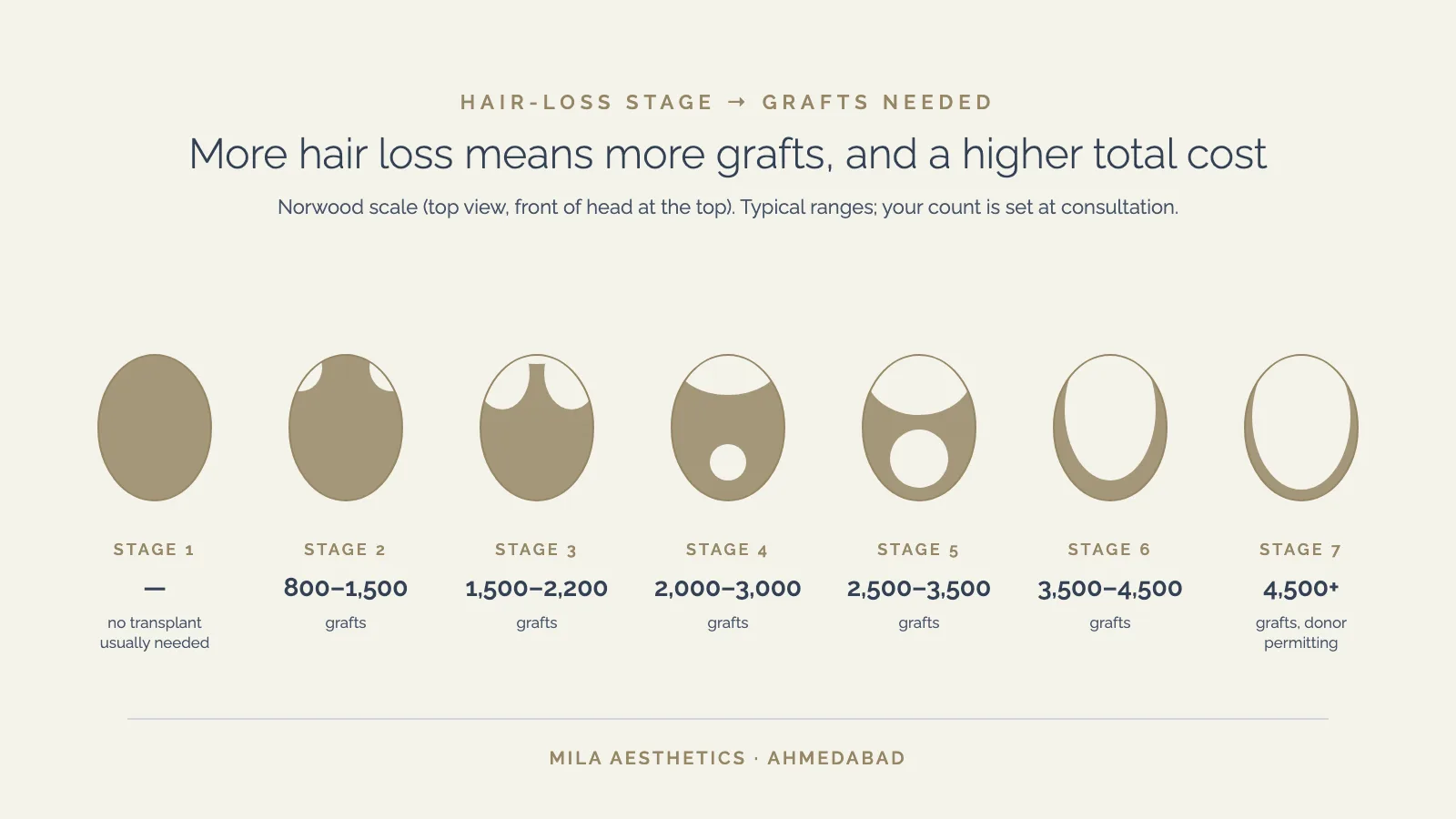
These are typical ranges, not fixed numbers. Your surgeon also looks at:
- Donor density: how many healthy grafts can be taken safely without thinning the back of the head.
- Hair thickness and type: thick or wavy hair gives more visual coverage per graft.
- Your goal: rebuilding a hairline needs fewer grafts than restoring full density to the crown.
- Your age and how your hair loss is likely to progress: a good plan leaves donor hair in reserve for the future.
If you’re in the early stages and unsure whether you need surgery at all, read why your hairline might be receding first.
FUE vs DHI cost: why DHI is more expensive
Both techniques extract grafts one by one from the donor area. The difference is in how the grafts are placed.
FUE (Follicular Unit Extraction)
The surgeon creates tiny recipient channels first, then places the grafts into them. It is a well-established technique that suits most patients and larger sessions, which is why it usually has the lower per-graft cost.
DHI (Direct Hair Implantation)
Each graft is loaded into a fine implanter pen and placed directly, controlling angle, depth and direction in one step. That gives fine control for hairlines and lets the surgeon work between existing hair without shaving the whole head. It also takes longer, uses single-use implanter tools and needs a larger skilled team. Those are the main reasons DHI costs more.
Neither is “better” for everyone. For a detailed comparison, see our guide on DHI vs FUE hair transplant. Many plans at MILA use a combination of FUE and DHI: FUE for coverage and DHI for the hairline.
Estimated hair transplant cost by number of grafts
Using the indicative per-graft ranges above, here is roughly what different session sizes cost in Ahmedabad:
| Grafts | Typical stage | FUE estimate | DHI estimate |
|---|---|---|---|
| 1,000 | Stage 2 / hairline only | ₹30,000 – ₹60,000 | ₹50,000 – ₹1 lakh |
| 1,500 | Stage 2–3 | ₹45,000 – ₹90,000 | ₹75,000 – ₹1.5 lakh |
| 2,000 | Stage 3 | ₹60,000 – ₹1.2 lakh | ₹1 lakh – ₹2 lakh |
| 2,500 | Stage 4 | ₹75,000 – ₹1.5 lakh | ₹1.25 lakh – ₹2.5 lakh |
| 3,000 | Stage 4–5 | ₹90,000 – ₹1.8 lakh | ₹1.5 lakh – ₹3 lakh |
| 4,000+ | Stage 5–6 | ₹1.2 lakh – ₹2.4 lakh+ | Often FUE + DHI combined |
Estimates only. GST, PRP/GFC sessions and medicines may be extra depending on the clinic. Very large sessions may be split over two sittings.
7 factors that change your final price
1. Number of grafts
The biggest factor by far. It is set by your hair-loss stage, donor capacity and the density you want.
2. Technique
FUE, DHI or a combination. DHI or combination plans cost more per graft than FUE alone.
3. Who performs the surgery
At some low-cost centres most of the work is done by technicians. At a surgeon-led clinic, a qualified plastic surgeon designs the hairline and oversees the procedure. That expertise costs more, and it is also what protects your donor area and gives you a natural result.
4. Hairline design and planning
A natural hairline isn’t a straight line. It follows your face shape, age and natural hair direction. Time spent on design shows in the final result. Here’s what “natural-looking results” really means.
5. Facility and sterility standards
An accredited procedure room, sterile single-use instruments and proper graft-storage solutions all add cost, and all reduce risk.
6. Area being treated
Scalp, crown, beard and eyebrow transplants differ in graft count and in how much precision placement they need. Eyebrows need few grafts but very careful angling.
7. Aftercare included
Check whether the post-op kit, the first wash, follow-up visits and any PRP or GFC sessions are included or billed separately.
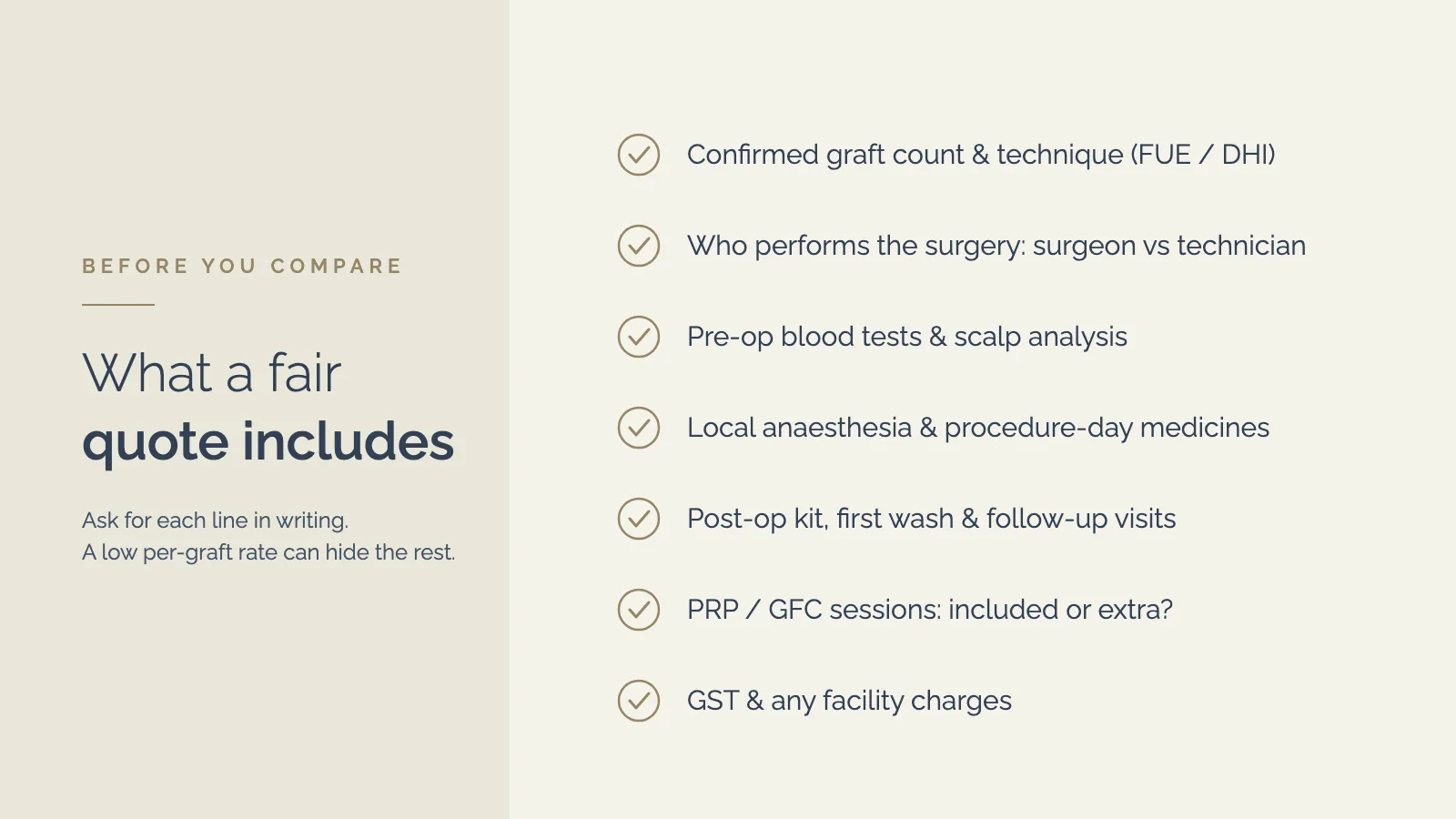
What a fair hair transplant quote should include
When you compare clinics, ask each one to put these items in writing. If a clinic won’t confirm a graft count or tell you who performs the surgery, take that as a warning sign.
Why a very cheap hair transplant can cost you more
A ₹15-per-graft offer is tempting. But in hair restoration the cheapest option often becomes the most expensive one over time. These are the problems we see most often in people who come to us after a low-cost procedure elsewhere:
- Over-harvested donor area: too many grafts taken from one spot leave the back of the head visibly thin. That can’t be undone, and it limits any future procedure.
- Unnatural hairlines: hairlines that are too low, too straight or planted at the wrong angle look “done” rather than natural.
- Low graft survival: grafts that are handled badly or kept out of the body too long don’t grow, so you pay for hair you never get.
- Correction costs: repairing a poor result usually costs more than doing it well the first time, and some damage can’t be fully reversed.
Before you book, it’s worth reading what to consider when choosing an aesthetic clinic in Ahmedabad and our list of hair transplant myths to stop believing.
Ongoing costs to plan for
Transplanted hair is generally permanent, because it comes from DHT-resistant donor follicles. Your existing native hair can still thin over time, though, so a realistic budget also covers:
- Supportive therapy: PRP, GFC or mesotherapy sessions are often advised after surgery to support healing and protect existing hair. Read more about GFC hair treatment results.
- Medication: your doctor may prescribe medicines to slow further loss. Take these only under medical advice.
- A possible second session: if hair loss continues, or you want more density in the crown, a future session may be planned.
What you’re actually paying for: a 12-month result
A hair transplant isn’t an overnight change. Transplanted hair usually sheds within the first few weeks. That’s normal and expected. New growth starts around month three, and the final result settles over about a year.
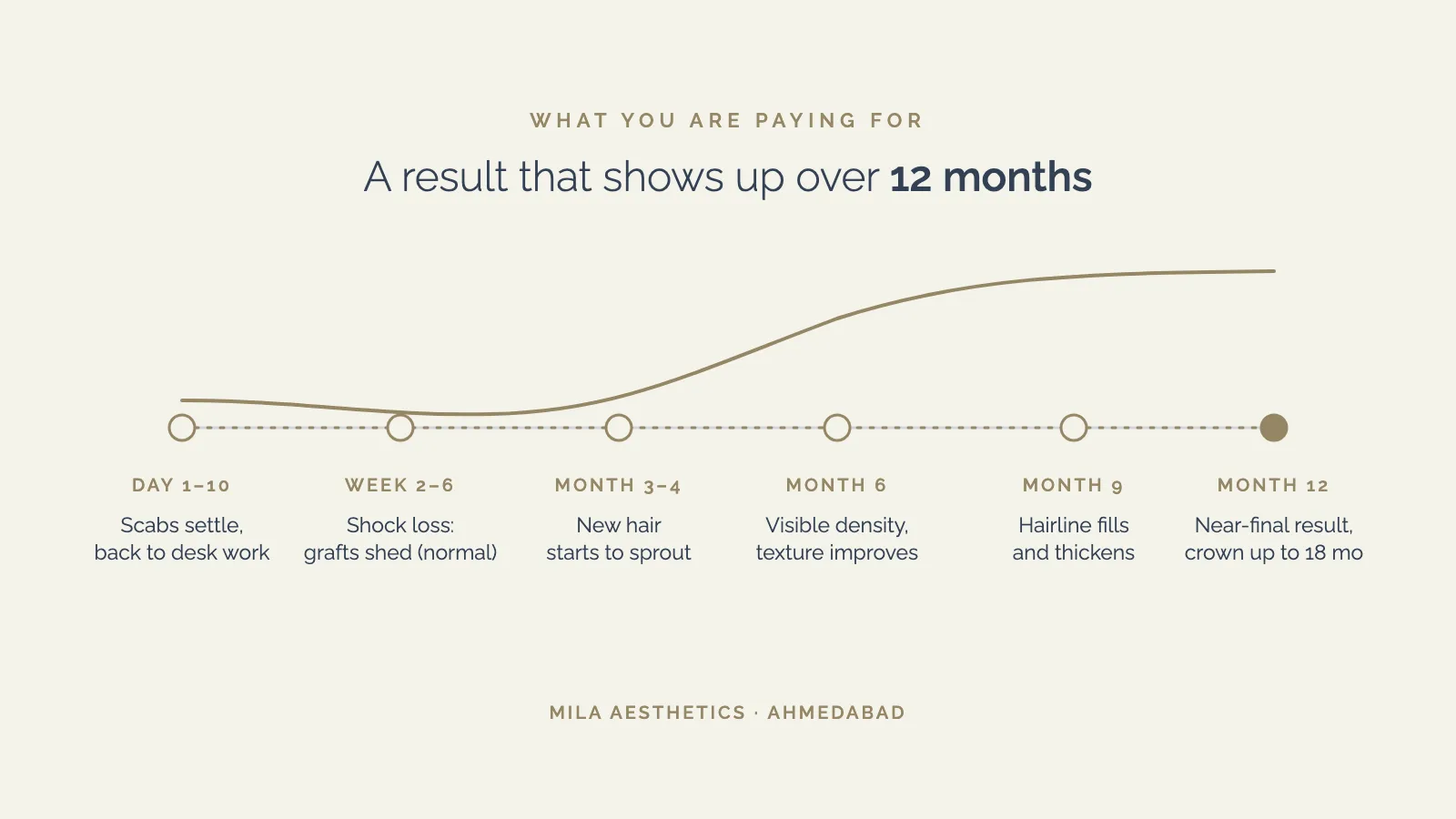
That’s why price-per-graft is only half the picture. What matters is how many of those grafts grow, and whether the result looks natural at month twelve and beyond. If this is your first procedure, here are things to know before your first hair transplant.
Is a hair transplant worth the cost?
For the right candidate, it is often one of the most cost-effective aesthetic treatments over time. You pay once for hair that can last a lifetime, instead of paying for hair systems, concealers or temporary fixes year after year.
It isn’t right for everyone, though. If your hair is thinning but follicles are still active, non-surgical treatment may be the better first step. Our guide to PRP vs hair transplant explains how to tell the difference.
How MILA Aesthetics plans your hair transplant
At MILA Aesthetics in Bodakdev, Ahmedabad, every hair restoration plan begins with a hair transplant assessment at no cost. During your visit, our plastic surgery team will:
- Assess your hair-loss stage and how it is likely to progress
- Evaluate your donor area’s density and safe graft capacity
- Design a hairline that suits your face, age and natural hair direction
- Recommend FUE, DHI or a combination, and explain why
- Give you a clear, itemised quote with a confirmed graft estimate
No pressure and no guesswork: just an honest plan and an honest number.
Frequently asked questions
What is the cost of a hair transplant in Ahmedabad in 2026?
Most hair transplants in Ahmedabad cost between roughly ₹30,000 and ₹3 lakh, and a typical 2,000–2,500 graft session costs about ₹60,000 to ₹2.5 lakh. The total depends mainly on how many grafts you need, the technique (FUE or DHI) and who performs the surgery. Your exact figure is set after a scalp assessment.
What is the cost per graft in Ahmedabad?
Indicative 2026 market rates are about ₹30–₹60 per graft for FUE and about ₹50–₹100 per graft for DHI. Always confirm what the per-graft rate includes.
How much does a 2,000 graft hair transplant cost?
At indicative market rates, 2,000 grafts costs roughly ₹60,000 to ₹1.2 lakh with FUE and ₹1 lakh to ₹2 lakh with DHI.
Why is DHI more expensive than FUE?
DHI uses single-use implanter pens and needs more time and a larger skilled team, because each graft is loaded and placed directly without pre-made channels. That extra time and equipment raises the per-graft cost.
Is a hair transplant a one-time cost?
The transplanted hair is usually permanent, but many people also budget for supportive treatments such as PRP or GFC and medication to protect existing hair. If hair loss continues, a second session may be planned in the future.
Does MILA Aesthetics offer a free hair transplant assessment?
Yes. MILA Aesthetics in Bodakdev, Ahmedabad offers a hair transplant assessment at no cost, where your hair-loss stage, donor area and graft estimate are reviewed before any quote is given.
Final thoughts
The cost of a hair transplant in Ahmedabad comes down to three things: how many grafts you need, how they’re placed, and who places them. Compare quotes line by line, ask who performs the surgery, and judge each clinic on the result you’ll see at month twelve, not only the price on day one.
Find out your exact graft count & cost
Visit MILA Aesthetics, Sylph 203, Sindhu Bhavan Marg, Bodakdev, Ahmedabad.
WhatsApp us Call 83474 47477