

Dark circles are one of the most common reasons people say they look tired, even after a good night’s sleep. Concealer helps for a day, but it rarely fixes the problem, because “dark circles” is a single name for several different causes.
Some dark circles are pigment in the skin, some are blood vessels showing through thin skin, and many are actually under-eye hollows casting a shadow. This guide explains how to tell which type of dark circles you have, and which treatment matches each one.
Dark circles usually come from one of three causes: pigmentation (brown, very common in Indian skin), visible blood vessels (bluish or purple, through thin skin) or under-eye hollows (a shadow from lost volume). Pigment responds to sun protection, peels and selected lasers; vascular circles to skin-strengthening treatments; and hollows to under-eye fillers or fat transfer. Many people have more than one type.
The 3 types of dark circles
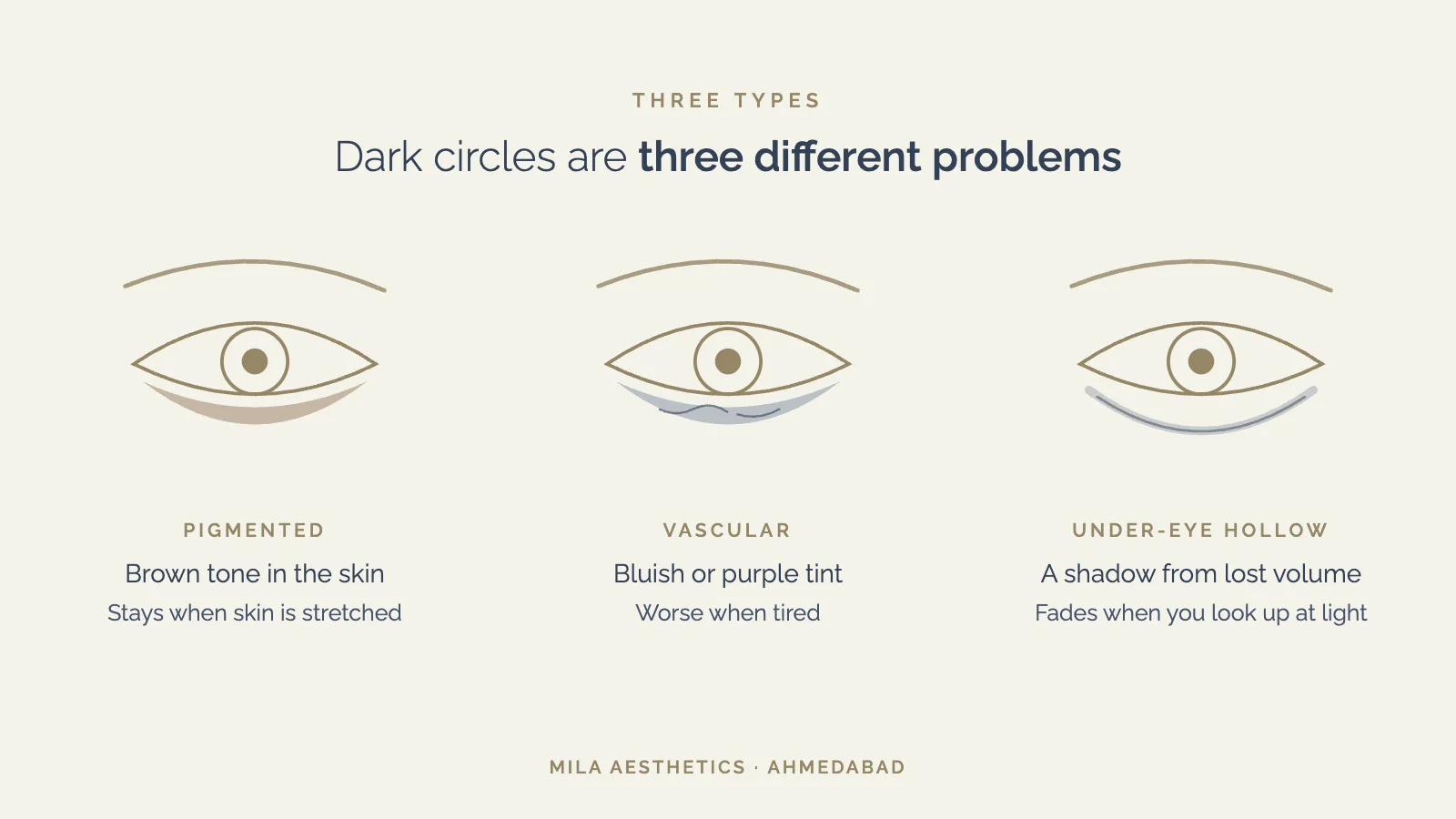
1. Pigmented circles
These look brown or greyish-brown and sit in the skin itself. They are especially common in Indian skin, often run in families, and get darker with sun exposure, rubbing and allergies.
2. Vascular circles
These look bluish, purple or pinkish. The skin under the eyes is among the thinnest on the body, so the blood vessels beneath it can show through. They often look worse when you are tired, unwell or after a late night.
3. Under-eye hollows (structural)
Here the darkness is a shadow. With age, or because of the shape of your face, volume under the eye is lost and a groove forms between the lower eyelid and the cheek, called the tear trough. Light from above leaves that groove in shadow, which reads as darkness.
How to tell which type of dark circles you have
These simple checks help, but a doctor’s assessment is the reliable way to know, because most people have a mix.
| Check | Pigment | Vascular | Hollow |
|---|---|---|---|
| Colour | Brown | Blue, purple or pink | Grey shadow |
| Gently stretch the skin | Colour stays | Often looks more blue | Shadow softens |
| Look up at a light, or lie down | No change | Little change | Shadow fades |
| Worse with | Sun, rubbing, allergies | Tiredness, late nights | Overhead light, ageing |
What makes dark circles worse
- Sun exposure: deepens pigmentation under the eyes.
- Rubbing the eyes: often linked to allergies or eczema, it darkens the skin over time.
- Poor sleep and dehydration: make vascular circles and puffiness more visible.
- Ageing: thinner skin and loss of volume make hollows and vessels more obvious.
- Genetics: deep-set eyes or a naturally prominent tear trough run in families.
- Smoking: damages collagen and slows skin repair.
If your whole complexion looks tired, our guide on why skin looks dull even with a skincare routine may also help.
Treatments for dark circles by type
The best results come from matching the treatment to the cause. Treating hollows with creams, or pigment with filler, usually disappoints.

For pigmentation
- Daily sun protection around the eyes, including sunglasses.
- Prescription creams chosen by a doctor for the delicate under-eye skin.
- Gentle chemical peels designed for the eye area.
- Selected laser treatments, used with settings suited to Indian skin to avoid worsening pigment.
For visible blood vessels
- Skin boosters to improve skin quality and thickness under the eyes.
- Treating allergies and improving sleep, which often makes a visible difference.
- Some laser treatments that target small blood vessels, in selected cases.
For under-eye hollows
- Tear trough fillers: a soft hyaluronic acid filler placed carefully to smooth the groove and lift the shadow.
- Facial fat transfer: your own fat used to restore volume, often longer lasting. Our comparison of fat transfer vs dermal fillers explains the trade-offs.
- Lower blepharoplasty: eyelid surgery when puffy bags, not just hollows, are the main problem.
Under-eye fillers: what to know
Under-eye filler can give a natural, refreshed result when the cause of dark circles is a hollow. It is also one of the most technically demanding areas to inject, so the injector’s experience matters.
- Not for everyone: filler does not lighten pigment and can make puffy bags look worse.
- Common, short-lived effects: swelling, bruising and tenderness for a few days.
- Too much or too shallow: can leave a puffy look or a bluish tint, which an experienced doctor works to avoid.
- Rare but serious risks: such as blocked blood vessels, which is why under-eye filler should only be done by a qualified medical professional.
- Duration: results usually last many months, varying with the product and the person.
What you can do at home for dark circles
- Wear sunscreen and sunglasses every day.
- Avoid rubbing your eyes, and treat allergies or eczema with your doctor.
- Keep a regular sleep routine and drink enough water.
- Use a cold compress in the morning to reduce puffiness.
- Be cautious with strong actives near the eyes, which can irritate and darken the skin.
Sun damage also builds up over years; read how sun damage affects your skin. The American Academy of Dermatology offers further patient information on skin care.
Combining treatments for dark circles
Because most people have more than one cause, the best results often come from a short, planned combination rather than a single procedure.
- Pigment plus hollows: sun protection and peels to lighten the skin, then a small amount of filler to soften the shadow.
- Thin skin plus hollows: skin boosters to improve skin quality before or alongside volume treatment.
- Bags plus hollows: lower eyelid surgery to remove or reposition fat, sometimes with fat transfer to smooth the area.
How many sessions will I need?
Peels and lasers for pigmentation are usually done as a course of sessions a few weeks apart, with results building gradually. Skin boosters are also given as a short series. Filler for hollows is often a single appointment with a review visit, and fat transfer or eyelid surgery is a one-time procedure with a longer recovery.
What results are realistic?
Expect a fresher, more rested look rather than a perfectly even under-eye. Pigmentation can lighten noticeably but may return without daily sun protection, and genetic circles tend to improve rather than disappear. A good doctor will explain which part of your under-eye darkness each treatment can and cannot change.
Dark circles treatment at MILA Aesthetics
At MILA Aesthetics in Bodakdev, Ahmedabad, a doctor first identifies which type of dark circles you have, then recommends the treatment, or combination, that fits the cause. That first step is what turns repeated short-term fixes into a lasting improvement.
Frequently asked questions
Can dark circles be removed permanently?
It depends on the cause. Hollows can be improved for a long time with filler or fat transfer, while pigment and visible vessels usually need ongoing care, such as sun protection and maintenance treatments.
Do under-eye creams work on dark circles?
Some prescription creams can help pigmentation. Creams do not fill hollows or change the shadow they cast.
Are under-eye fillers safe?
When done by an experienced, qualified doctor, under-eye fillers are generally safe, though swelling and bruising are common for a few days and rare serious risks exist.
How long do under-eye fillers last?
Results usually last many months, and often longer in this area, but duration varies with the product used and the individual.
Why do I have dark circles even when I sleep well?
Pigment, genetics and under-eye hollows all cause dark circles that sleep does not change. Identifying the type is the first step to the right treatment.
Is laser safe for dark circles on Indian skin?
Selected lasers can be used safely on Indian skin with the right settings and an experienced operator. Incorrect settings can worsen pigmentation, so a medical assessment comes first.
Final thoughts
Dark circles are not one problem but three: pigment, blood vessels and hollows. Once you know which you have, the right treatment becomes clear, whether that is sun care and peels, skin boosters, or a carefully placed filler.
Find the right treatment for your dark circles
Visit MILA Aesthetics, Sylph 203, Sindhu Bhavan Marg, Bodakdev, Ahmedabad.
WhatsApp us Call 83474 47477